

Project
The railways and their staff are facing crucial changes that will determine the future of this important sector.
These changes are of wide scope as they have implications on technological, demographic, structural, legal and regulatory domains.
The urgency of its needs is justified by the present stage of the sector and also by a recent widespread and intense impetus towards
leveraging railways in Europe.
Rail Transport is a future oriented industry, striving to offer an even more attractive, affordable, safe, clean, competitive and
reliable transport mode. Also the European Manufacturing Industry is now considered a genuine economic strength for Europe with a
70% of the world market valued at 70 billion Euros.
Integrated European railway system is yet to be achieved with individual railway companies running cross border train operations
under their own responsibility from origin to destination. With the aim to improve overall services railway companies are now
starting building alliances with partners, both from within the sector, and from other transport modes. Major efforts are being
developed, through research and development to implement uniform assessment procedures, standardisation and modularity with the
aim to provide conditions for repair and maintenance activities to be carried out everywhere in Europe.
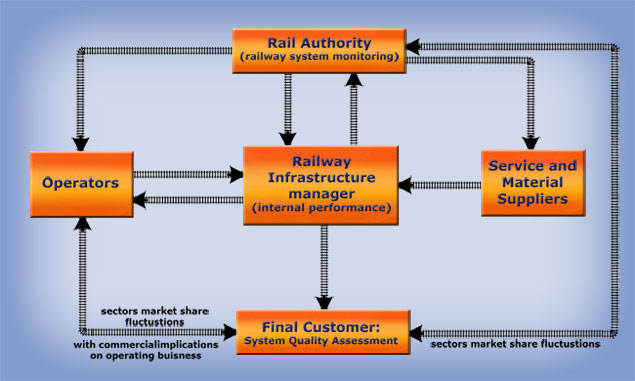
The figure above highlights the institutional scope where authorities, regulators, operators, suppliers, etc.,
have all to be engaged, and identifies the gap where FUTURAIL will act by matching demand and supply of the required skills and
competencies to foster the development of the sector and consequently of more job opportunities and faster incorporation of
young talents in the sector.
 top of page